AI in Business: Where It Actually Helps
A grounded look at where artificial intelligence tools deliver consistent value for small businesses — and where the hype gets ahead of reality.
Read ArticleWe help small and medium-sized businesses explore where AI tools can genuinely reduce manual effort, improve response times, and support better decisions — without the hype or unrealistic promises.
Select the area that matters most to your operation to see what's realistically possible with current AI tools.
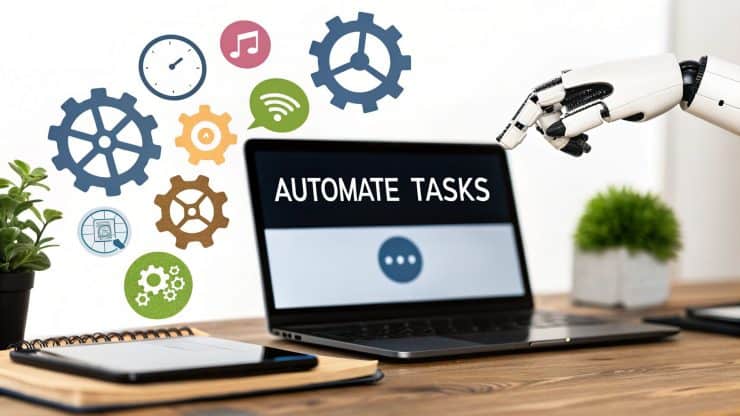
Many operational tasks — data entry, report generation, file organisation, approval routing — follow predictable patterns that software can handle reliably. AI-assisted automation adds a layer of intelligence to these flows, helping handle variation and exceptions rather than just rigid rule-based scripts.
This doesn't mean automating your entire operation overnight. It typically starts with identifying one or two high-volume, time-consuming tasks and building reliable automations around those first.
Automatically pull data from multiple sources into a structured summary on a set schedule.
Route documents or requests to the right person based on content, reducing back-and-forth.
Keep data consistent across your CRM, accounting, and project management tools automatically.
An AI assistant configured for your business can handle a meaningful portion of routine inbound questions — things like product availability, service details, FAQs, booking processes — freeing your team to focus on more complex conversations that genuinely require human judgement.
The effectiveness depends heavily on how well the assistant is configured and how clearly your information is documented. Setup takes time, but a well-built assistant can handle high volumes consistently.
Answer common questions about your services, hours, pricing, and processes around the clock.
Guide customers through booking or enquiry forms without staff involvement for standard requests.
Help team members quickly find answers from internal documentation, policies, or procedures.

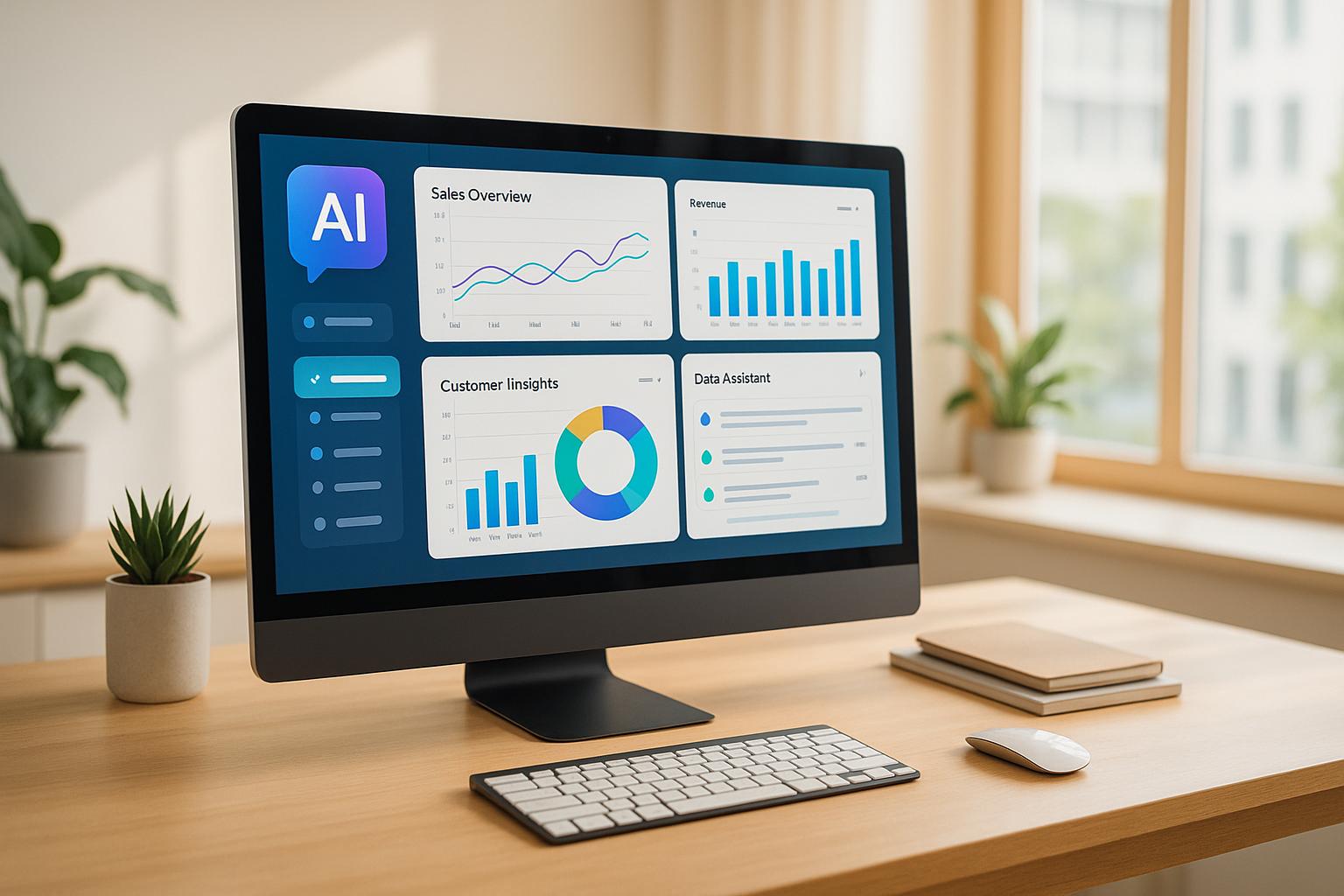
Most businesses accumulate far more useful data than they actually review. AI-assisted analysis tools can surface patterns, flag anomalies, and generate plain-language summaries of complex data sets — helping decision-makers act on evidence rather than intuition alone.
This works best when you have structured data and a clear question you want answered. Vague inputs produce vague outputs. The setup process typically begins with defining what decisions the analysis is meant to support.
Identify which products, channels, or customer segments are growing or underperforming.
Flag unusual patterns in financial data, inventory, or customer behaviour before they become problems.
Generate structured, plain-language summaries from raw data on a schedule that suits your team.
Customer communication often breaks down when volume spikes or when processes aren't well-documented. AI-powered systems can help standardise outreach, automate follow-up sequences, and ensure nothing slips through the cracks — across email, chat, and web form channels.
These systems work alongside your team, not as a replacement. They handle the predictable parts of communication so your team can focus on complex or sensitive conversations.
Send timely, relevant follow-up messages after enquiries, consultations, or purchases.
Categorise and route inbound enquiries based on content, urgency, or service type.
Keep team members informed about relevant updates without manual monitoring of multiple platforms.

Four focused practice areas where we've developed practical experience helping Canadian businesses integrate AI tools that work reliably in real-world conditions.
We map your existing processes, identify where repetitive manual steps create bottlenecks, and design automated flows that handle those steps reliably — with human oversight where it matters.
Realistic expectation: Automation reduces time spent on targeted tasks. It doesn't eliminate the need for human review of complex edge cases.
Learn MoreWe build and configure AI assistants trained on your business information — product details, service processes, FAQ content — that can handle routine queries across web, email, or internal platforms.
Realistic expectation: AI assistants perform well on structured, documented content. Novel or highly sensitive enquiries still require staff attention.
Learn MoreWe help you get more value from the operational data your business already generates — building dashboards, automated summaries, and pattern-detection tools that surface useful insights without requiring a data science team.
Realistic expectation: Analysis tools surface patterns and anomalies. Strategic decisions still require business context that humans provide.
Learn MoreWe design and implement communication workflows that use AI to handle the predictable parts of customer interaction — routine follow-ups, triage, acknowledgements — while keeping your team involved where genuine judgement is needed.
Realistic expectation: Automated communication handles volume efficiently. Relationship-building and complex customer situations remain human responsibilities.
Learn MoreWe follow a deliberate, phased process that keeps your team involved at every stage. There are no black-box solutions here — you'll understand what's been built and why.
About Our ApproachWe start by understanding your current workflows, tools, and pain points through structured conversations with your team. This is where we determine whether AI tools are genuinely applicable to your situation and where they'd have the most impact.
Based on what we learn in discovery, we develop a clear scope — specifying what will be built, what it will do, and what it won't do. We discuss realistic timelines and set measurable success criteria before any development begins.
Our team configures and integrates the chosen tools with your existing systems. We build in testing phases and keep you informed of progress throughout, addressing any technical or process issues before rollout.
We don't hand over a system and disappear. We work with your team to ensure they understand how to use, monitor, and maintain what's been built — including when to intervene manually and how to identify if something isn't working as expected.
After implementation, we review performance against the success criteria we defined in the scoping phase. Most systems benefit from adjustment once they're operating with real data, and we support that ongoing refinement.
Take one of our short assessments to better understand where AI tools fit your current situation — and where they might not.
These are illustrative examples of how AI tools are applied across different business types — not promises of specific outcomes.

By connecting their accounting software to a templated reporting automation, a small firm was able to generate client-ready summaries with significantly less manual formatting — freeing staff time for review and client communication.
Illustrative example — results vary by setup and data quality.
After configuring an AI assistant with their product catalogue and return policy details, an online retailer found that a portion of common customer questions were being answered consistently without staff involvement — particularly outside business hours.
Illustrative example — results vary by setup and data quality.By implementing an AI-assisted intake form and automated follow-up sequence, a catering company reduced the back-and-forth for standard event bookings — capturing requirements more completely upfront and reducing scheduling errors.
Illustrative example — results vary by setup and data quality.A small, experienced team with backgrounds in business operations, software development, and practical AI implementation.

15 years in business operations before transitioning to AI consulting. Focused on practical implementation over technical complexity.
Software engineering background with specialisation in API integrations and automation platforms used by SMEs.

Works with clients on data infrastructure and builds reporting systems that give teams actionable visibility into their operations.

Manages onboarding and ongoing support relationships, ensuring clients understand and can effectively use what's been built.
We think honesty about what AI can and can't do is more valuable than an impressive sales pitch. These principles shape every client relationship.
We define measurable success criteria before starting any project. If we can't define what good looks like, we don't start.
We don't make income claims or guarantee specific outcomes. AI tools have real limitations and we explain them plainly.
We follow Canadian privacy regulations in all client work. Client data is handled with clear, documented protocols.
Everything we build is documented. Clients receive full records of what was implemented and how it works.
Your team is part of the build process. We don't create solutions in isolation and hand them over at the end.
We comply with relevant Canadian consumer protection standards and advertising policies in all our communications.
Practical, non-promotional writing about AI applications for small and medium-sized businesses.

A grounded look at where artificial intelligence tools deliver consistent value for small businesses — and where the hype gets ahead of reality.
Read Article
Workflow automation is one of the most overused phrases in business tech. Here's what it actually means in practice for a typical SME.
Read Article
How businesses are actually using AI assistants in their day-to-day — the successes, the limitations, and what makes the difference between a useful tool and a frustrating one.
Read ArticleStill have questions? Get in touch — we're happy to discuss your specific situation.
Tell us about your current workflows and challenges. We'll give you a straightforward assessment of where AI tools could help — and where they probably wouldn't.